Steps to Begin Your Homeopathic Treatment at Dr. Peter's Clinic: Step - 1: Consultation Call Contact Dr. Peter's Clinic at 9499037394 for a brief discussion about your case with Dr. Peter. Step - 2: Payment Process To proceed, you can make the payment for consultation via UPI like Google Pay, PhonePe, Paytm, etc. Your payment will be confirmed, or Dr. Peter's Clinic will call you to help you through the process. Step - 3: Receive your Medicines Send your residential address to Dr. Peter's Clinic through SMS or WhatsApp. Your medicines with bill will be sent through courier to your home. Step - 4: Call for instructions on how to take Medicines After receiving medicines call Dr. Peter's Clinic at 9499037394 for instructions on how to take the medicine and other instructions regarding dietary management and lifestyle changes according to your disease. Step - 5: Payment for Medicines You can make payment for medicines after you receive medicines to your home. Upon re...
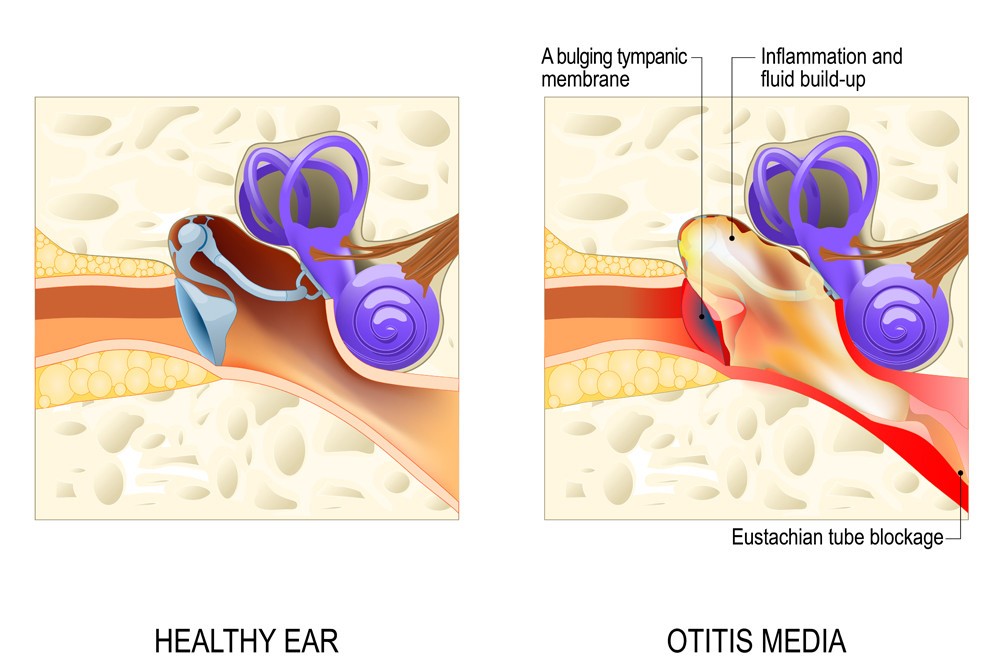
Acute Suppurative Otitis Media (ASOM) is the acute inflammation of the middle ear by pus-forming organisms which are also called suppurative or pyogenic organisms. It is most common in infants and children. But it can occur in adults too. Infants and children who are between the age of 6 months and 6 years get recurrent episodes of acute inflammation of the middle ear, usually around four to five times a year. Such a condition is given the name of recurrent acute otitis media.
Such children usually have an underlying cause like recurrent sinusitis, hypertrophy of the adenoid, tonsillitis, allergy, immune deficiency, etc. Feeding the babies in a complete supine position may also cause the milk to enter the middle ear directly which can lead to a middle ear infection. Children with recurrent colds, allergies, immune deficiency, and respiratory diseases are more likely to get otitis media.
Keywords: Middle ear infection, symptoms of middle ear infection, ear infection symptoms, ear infection causes, stages of otitis media, ear infection treatment.
Causative organisms:
The most common organisms are Streptococcus pneumoniae, Haemophilus influenza, and Moraxella catarrhalis. Other organisms such as Streptococcus pyogenes, and Staphylococcus aureus can also cause acute otitis media.
Routes of Infection:
The most common route of infection is through the Eustachian tube. This tube is shorter and wider in infants and young children, hence the higher incidence.
Through traumatic perforations of the tympanic membrane due to any cause like a foreign body, etc.
Stages with Signs and Symptoms:
1. Stage of Tubal occlusion:
In this stage, there is edema and congestion at the nasopharyngeal end which closes the tube leading to negative pressure within the middle ear. So there will be a retraction of the tympanic membrane with a minimal amount of fluid in the middle ear.
Symptoms during this stage are conductive deafness and earache. There will not be a fever during this stage.
On examination, the tympanic membrane will be retracted and there will be a loss of light reflex. Rinne’s and Weber’s tests show conductive deafness.
2. Stage of Presuppuration:
The suppurative organisms invade the middle ear cavity and cause hyperemia and congestion. This leads to the production of inflammatory exudate in the middle ear.
Symptoms – there will be throbbing prominent earache which disturbs sleep. Deafness and tinnitus (ringing in the ears) are usually told by adult patients. There will be a high fever during this stage.
On examination, there will be the cart-wheel appearance of the tympanic membrane. Rinne’s and Weber’s tests show conductive deafness.
3. Stage of Suppuration:
In this stage, the tympanic membrane starts to bulge due to increased pus formation in the middle ear and in the mastoid air cells.
Symptoms include excruciating severe earache, high fever, and a progressive increase in deafness. In some children, there may be convulsions too.
On examination, the tympanic membrane is bulging with a yellow spot where rupture is inevitable. Tenderness over the mastoid process may be elicited.
4. Stage of Resolution:
The earache subsides due to the rupture of the tympanic and the release of pus. This is followed by the resolution of the inflammatory process. Treatment should be given early as soon as possible which leads to resolution without the rupture of the tympanic membrane.
Symptoms – the earache becomes relieved and the fever comes down.
On examination, a small perforation is seen in the anteroinferior quadrant of the pars tensa (the tense portion of the tympanic membrane) and there may be blood-tinged discharge in the external auditory canal. During resolution, the hyperemia of the tympanic membrane decreases and it returns to its normal color.
5. Stage of Complication:
Either if the virulence of the organisms is high or if the immunity of the patient is poor, resolution may not occur. The disease will spread beyond the middle ear and leads to complications such as acute mastoiditis, facial paralysis, meningitis, brain abscess, subperiosteal abscess, etc.
General Management for Acute Suppurative Otitis Media:
The discharge in the ear should be wiped with sterile cotton buds.
Use a warm compress outside the ear but don’t do it in infants.
Never self-medicate with aspirin in children as it will cause Reye’s syndrome.
Consult a physician as soon as possible.
Prevention of Acute Suppurative Otitis Media:
Breastfeed for the first 6 months as the antibodies in breast milk decrease the chance of ear infection.
Breastfeed or bottle-feed with the head above the level of the stomach.
Don’t smoke near infants and children.
Maintain strict hygiene with infants and children as most infection starts from a cold attack.
Other types of Otitis Media:
Otitis Media with Effusion: It is also called glue ear. It is characterized by the accumulation of non-purulent effusion in the middle ear. Causes include viral infections of the upper respiratory tract, chronic sinusitis, rhinitis, unresolved ASOM, allergies, etc.
Aero-otitis Media: It is a nonsuppurative condition due to eustachian tube failure to maintain the pressure of the middle ear. The usual cause is rapid descent during air flight or during underwater diving.
Acute Necrotizing Otitis Media: It is caused by β-hemolytic streptococcus and is often seen in children with influenza, measles, or scarlet fever. There will be profuse ear discharge and rapid destruction of the tympanic membrane and even the mastoid air cells.
Chronic Suppurative Otitis Media: It is a long-standing infection of the middle ear with ear discharge and permanent perforation of the tympanic membrane.
Comments
Post a Comment